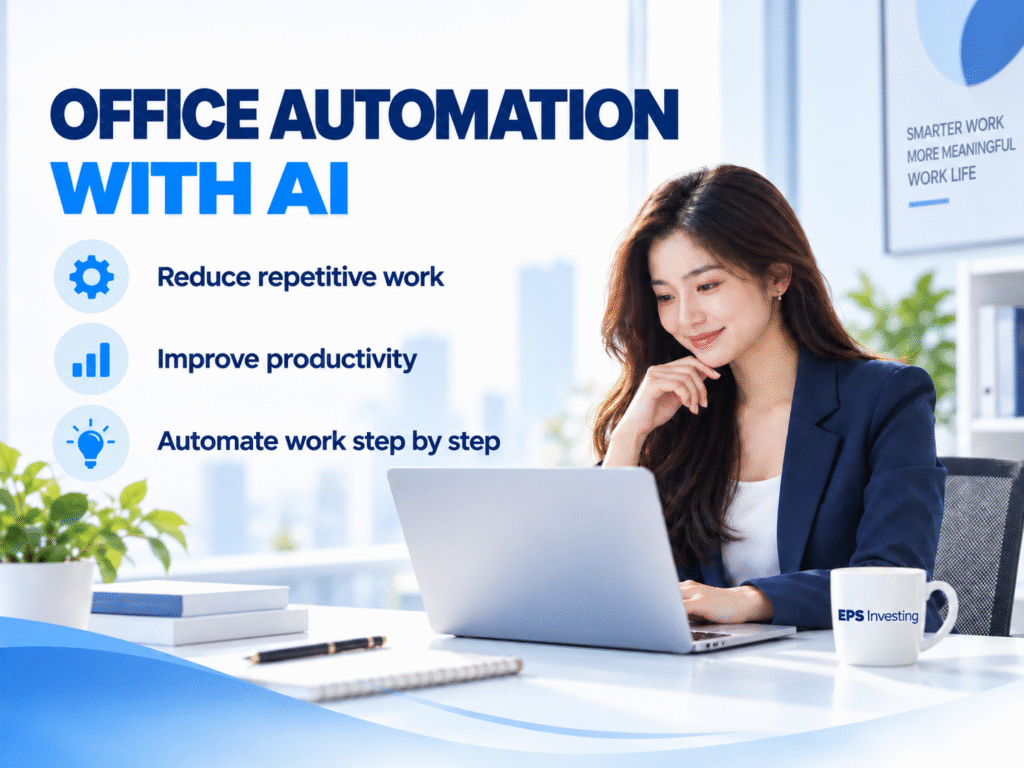
Office Automation with AI
Improve processes. Reduce manual work. Strengthen control and operating efficiency.
EPS reviews how work is currently performed, redesigns inefficient steps and implements AI and automation on the systems the company already uses.
When everyday work still depends too heavily on manual steps
Many businesses still rely on email, spreadsheets, manual data entry and information passed between multiple people. As work volume increases, processing slows, follow-up becomes harder and management information can become delayed or inconsistent.
AI and automation can address a meaningful part of these problems, but only when the business first understands the current process, identifies the real bottlenecks and redesigns the way the work should flow.
EPS approaches automation from a business and management perspective: understand the problem first, improve the process first, then select the appropriate technology.
Process first. Technology second.
EPS does not start by selling a software product or selecting a specific tool.
A poorly designed process does not become better simply because it is automated. The first step is to understand how the work currently flows, which steps are truly necessary, which can be removed or simplified, where the data needs to go and where people should remain in control.
Only then does EPS select the appropriate automation approach, prioritizing the systems the company already uses, such as Microsoft 365, Google Workspace, CRM, ERP and other management platforms.
In a Microsoft 365 environment, for example, Outlook, Excel, SharePoint, Teams, Power Automate, Copilot and other AI tools can be connected to support day-to-day work. Where deeper technical development or integration is required, EPS can work with the company’s technology team or appropriate technology partners.
How can a business process be improved?
For example, a work request can be handled through a connected sequence:
Email or request received → AI reads and classifies it → extracts information → updates the system → routes it to the responsible person → creates a response or document → tracks progress → sends reminders or alerts when action is needed.
Instead of an employee handling every step manually, the system can process the repetitive parts and involve people only where review, approval, discussion or judgment is required.
The objective is not simply to automate an isolated task, but to make the end-to-end workflow smoother, easier to control and more useful for management.
Start small and measure the results before scaling
A business does not need to begin with a large AI transformation program.
EPS can work with the company to select one process that consumes significant time, repeats frequently, is difficult to track or has clear potential to create value, and pilot the improvement first.
The results are then assessed using relevant measures such as processing time, reduction in manual effort, visibility over work status or the quality of management information. If the pilot creates value, the company can decide whether to expand to other processes.
Which processes can be improved?
Sales and Customer Management
- Receive and classify customer inquiries.
- Prepare quotations, proposals or sales documents.
- Update CRM records, track responses and create follow-up tasks.
- Collect and standardize information for sales teams.
Finance and Management
- Collect and consolidate data from multiple sources.
- Track receivables, cash flow and issues requiring attention.
- Prepare recurring management reports.
- Flag indicators or exceptions that require management attention.
Operations and Approvals
- Receive and process internal requests.
- Track approvals and handoffs between teams.
- Process documents, records and related data.
- Send reminders, track progress and flag exceptions.
Management and Internal Coordination
- Summarize meetings and create action lists.
- Track action items across teams.
- Consolidate information for meetings and decision-making.
- Store and retrieve information to support management.
These are only examples. The actual improvement opportunities depend on how the business operates, the data available and the systems it currently uses.
What can your business gain?
Depending on the selected area of work and the agreed scope, outcomes may include:
- A process reviewed and redesigned to be simpler, clearer and easier to control.
- Shorter processing times.
- Lower risk of missed follow-ups, delays or breakdowns during handoffs.
- Better visibility into work status and exceptions that require attention.
- Better updated and consolidated data for management.
- One or more workflows piloted or put into operation.
- Pilot results to support a decision on whether to scale.
- Guidance, handover and recommendations for the next improvement opportunities.
How does EPS implement process improvement with automation and AI?
1. Define the problem and the outcome required
EPS works with the company to define the problem to be solved, its impact on operations and the desired outcome. Priority is based on potential value, repetition, measurability and implementation feasibility.
2. Review and redesign the process
EPS works with management and the people directly involved to understand how the work is currently handled, the data and systems being used, handoffs between teams, control points and the steps that consume the most time. Unnecessary steps are removed or simplified before the target process is defined.
3. Define the appropriate role of automation and AI
EPS identifies which steps can be automated, where AI can support reading, classification, extraction, synthesis or content generation, and where human review, approval or judgment should remain in place.
4. Pilot, implement and measure
The workflow is introduced into the live working environment, tested with real cases, refined and measured using relevant indicators such as processing time, work volume, reduction in manual effort and visibility over exceptions.
5. Hand over and expand when appropriate
EPS guides the team, hands over the solution and works with the company to identify the next processes if the pilot shows that broader improvement would create value.
From one workflow to broader operational improvement
During a process review, an issue that initially appears to be about manual work may reveal broader weaknesses in process design, data, accountability, management reporting or coordination between functions.
In those situations, EPS can work with the company to expand the scope from one workflow into a broader operational improvement or corporate restructuring assignment. AI and automation then become implementation tools within a wider business improvement program.
Which process in your business needs improvement?
If your business has a process that consumes significant time, repeats frequently, is slow to handle or is difficult to control, EPS can review the current workflow, identify improvement opportunities and assess where automation or AI may be appropriate.