Operational Restructuring
EPS Investing provides operational restructuring advisory to improve management and business processes, increase productivity, strengthen performance and control costs. We work directly with business owners to identify bottlenecks, design practical solutions and support implementation, incorporating AI and automation where they add value.
Better Operations. Stronger Business Performance.
As a business grows, workloads increase and coordination becomes more demanding. Sales, approvals, document processing and reporting can become slow and cumbersome. Employees spend valuable time on repetitive tasks, while the business owner remains involved in too many day-to-day decisions.
These bottlenecks affect customer responsiveness, productivity, operating costs and the quality of management decisions. Adding staff or new software may have limited impact unless the underlying ways of working are improved.
EPS starts with how the business actually operates: reviewing workflows, clarifying accountability and information flows, redesigning processes and then selecting suitable technology to improve execution. Results are assessed against practical indicators such as turnaround time, productivity, costs, service quality and business performance.
Process ▸ Technology ▸ Finance reflects our approach: operational improvements should create tangible business value and, where reliable data is available, demonstrate measurable financial impact.
Signs Your Business Could Benefit from Operational Improvement
Both growing businesses and established companies can encounter these challenges:
- Sales teams spend excessive time researching prospects, preparing quotations and emails, tracking opportunities and updating customer records, resulting in inconsistent follow-up.
- Teams rely on manual work across spreadsheets, email and disconnected applications; information is entered repeatedly, errors occur and progress is difficult to track.
- Approvals, handovers and cross-functional coordination take too long, with unclear accountability causing delays and rework.
- Management reports arrive late, are inconsistent or require time-consuming manual consolidation, limiting timely decisions.
- Administrative costs rise as the business grows, without corresponding improvements in productivity or customer service.
- Operations depend heavily on the owner or a few key employees, while processes and controls have not kept pace with growth.
EPS can begin with one priority process or business challenge, then extend the engagement when implementation results support a broader scope.
Scope of Operational Restructuring Advisory
EPS tailors each engagement to the business’s objectives, operational complexity and available resources. The scope may include:
- Management and operating process redesign: review, simplify and redesign workflows, control points, information flows and coordination between departments.
- Sales and customer service processes: standardise lead intake, customer information management, quotations, opportunity tracking and after-sales follow-up to improve conversion and service quality.
- Productivity improvement and cost control: identify duplicate work, waiting time, errors and inefficient use of resources; define improvement initiatives and measurable indicators.
- Organisation, delegation and accountability: clarify roles, approval authority, coordination mechanisms and ownership of tasks to reduce dependence on individual intervention.
- Management information and reporting: improve how data is collected, maintained and used, and establish operational reports and indicators that support timely decisions.
- AI and process automation: identify appropriate uses of AI to support data handling, drafting, document classification, task tracking and employees working within redesigned processes.
- Implementation and change support: agree on a practical plan, assign responsibilities, guide teams in adopting new processes and measure results in day-to-day operations.
Each assignment is agreed around a defined scope, deliverables, responsibilities and performance measures, enabling the business to manage implementation costs and assess the return on its investment.
AI & Automation: Practical Tools for Operational Improvement
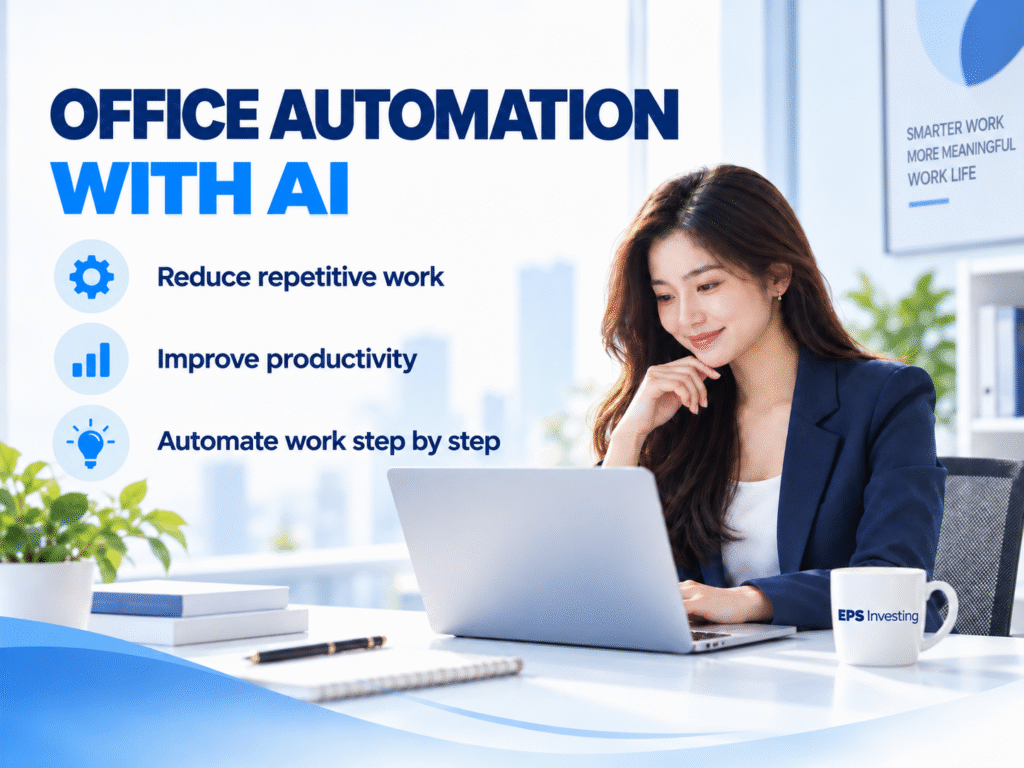
AI can accelerate repetitive tasks, make business information easier to use and reduce time spent on administration. EPS first identifies the business problem and designs the process, then selects appropriate technology based on the company’s data, people and existing systems.
Potential applications include:
- Sales: research and consolidate prospect information, prepare outreach emails, track responses and update a CRM or customer database.
- Office and document workflows: receive, classify and extract information, and draft or standardise documents within appropriate review and approval processes.
- Reporting and task management: consolidate data automatically, prepare recurring reports, monitor progress and send reminders according to assigned responsibilities.
- Internal knowledge access: support searching and using company documents and information with suitable access controls.
Where appropriate, EPS prioritises the platforms the business already uses, such as Microsoft 365 or Google Workspace. Before scaling an application, we consider cost, feasibility, access permissions, reliability of outputs and the operational benefits it is expected to deliver.
From Process Review to Measurable Results
EPS works with business owners and designated teams to develop changes that can be put into practice in day-to-day operations. A typical engagement follows five stages:
- 1. Define the objective: agree on the priority issue, scope, available data and indicators to improve.
- 2. Review the existing process: map workflows, speak with relevant employees and identify bottlenecks, unnecessary steps and control risks.
- 3. Design the improvement: define the future workflow, responsibilities, control points and opportunities to apply technology.
- 4. Implement and support adoption: pilot the changes at an appropriate scale, adjust them based on feedback and train teams to use the new process.
- 5. Measure the results: compare before-and-after indicators and identify further improvement opportunities or additional processes to address.
EPS focuses on solutions that are feasible, clearly owned and measurable. The scope, timeline and engagement arrangements are agreed to suit each business.

Start with a Focused Challenge. Expand as Results Emerge.
Businesses can choose an advisory scope that fits their priorities and resources. A company-wide restructuring programme is not necessary to get started.
Review a Priority Process
Assess one process—such as sales, document handling, approvals or management reporting—to identify bottlenecks, improvement opportunities and a suitable implementation scope.
Redesign and Implement the Process
Design the new workflow, standardise responsibilities and information flows, implement improvements, and introduce AI or automation where there is a clear business case.
A Phased Operational Improvement Programme
Improve several connected processes and management practices, monitor performance indicators and refine the approach as changes are adopted across the business.
Before work begins, EPS and the client agree on objectives, scope, deliverables and advisory fees.
Leadership Experience Grounded in Execution
EPS approaches operational restructuring from a business management perspective, combining experience in organisational management, finance, business processes and implementation. Our advisors’ prior executive experience informs this practical approach.

Le Trung Nam
CEO, EPS Investing
Le Trung Nam has over 25 years of experience in business management, finance and restructuring. He has held positions including CFO, CEO, Chairman of the Board and Board Member in industrial, construction and investment-related businesses.
At Steel Builder, he was involved in organisational restructuring, improvements to management processes and ERP implementation. Revenue doubled during his executive tenure. At Construction Joint Stock Company 47 (C47), he contributed to leadership and improvements in management and business performance; the company’s profit increased approximately sevenfold between 2019 and 2021. These examples reflect periods in which he held direct executive and governance responsibilities at the respective companies.
He holds a Bachelor’s degree in Corporate Finance and Accounting and a Master’s degree in Economics from the University of Economics Ho Chi Minh City (UEH). He attended the Fulbright Economics Teaching Program (FETP) and participated in innovation and business management training programmes in Finland and Germany.
Which Business Process Would You Like to Improve?
Tell us which process or business challenge is affecting productivity, costs, sales performance or management effectiveness. EPS can discuss a practical approach and a suitable advisory scope, starting with a focused assignment if appropriate.