

Strong growth in exports to the United States is usually viewed as positive news. However, as Vietnam’s trade surplus rises rapidly, businesses also need to recognise the other side of the story: Vietnamese goods may attract greater scrutiny, not only over pricing but also over origin, raw materials and the entire process through which a product is made.
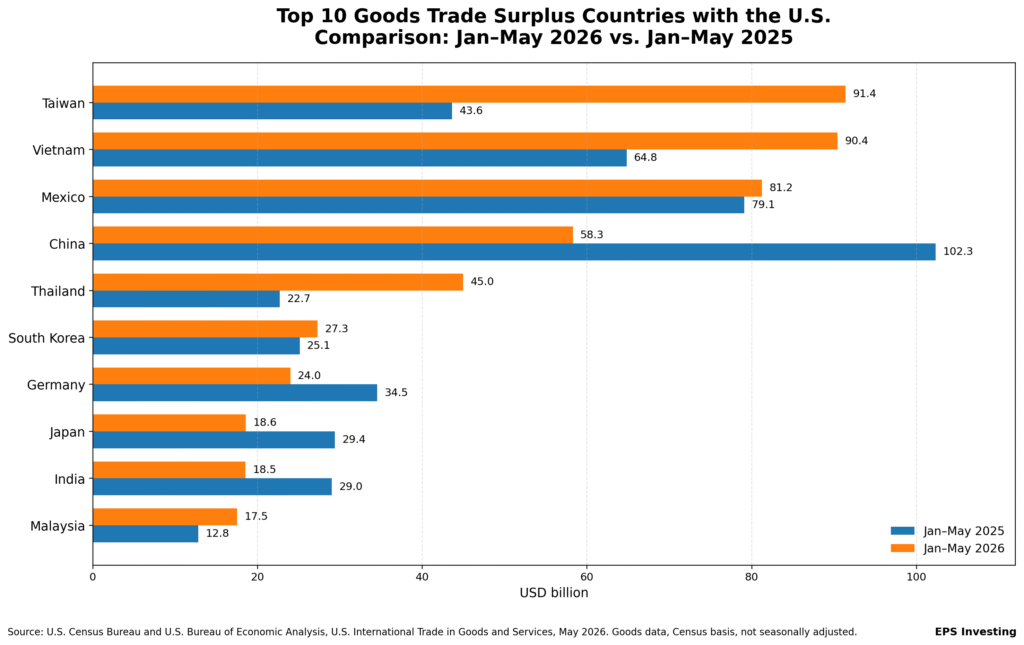
According to the May 2026 trade report published by the U.S. Department of Commerce, the United States imported approximately USD 98 billion worth of goods from Vietnam during the first five months of 2026, while exporting only about USD 7.6 billion to Vietnam. This resulted in a U.S. goods trade deficit with Vietnam of more than USD 90.3 billion, significantly higher than approximately USD 64.8 billion during the same period in 2025. In May 2026 alone, the deficit exceeded USD 20.3 billion.
The report does not conclude that the United States will immediately tighten inspections of Vietnamese goods. It is a statistical trade report, not a policy announcement. Nevertheless, the size and rapid growth of the deficit show that Vietnamese products are becoming increasingly visible in the U.S. market. When imports from one country grow quickly and create a widening trade imbalance, closer attention from regulators, industry associations and domestic manufacturers becomes a risk that Vietnamese companies need to consider.
1. A rapidly growing trade surplus is not only good news
In May 2026, Vietnam was among the trading partners associated with the largest U.S. goods deficits in the report. The U.S. deficit with Vietnam was higher than those recorded with Mexico, Taiwan and China during the month.
This does not necessarily mean that all Vietnamese goods will face a new general trade barrier. A more likely scenario is greater scrutiny of specific product categories, individual exporters and particular supply chains. Products with rapidly increasing export volumes, low prices, direct competition with U.S. manufacturers or a high proportion of imported inputs may attract greater attention.
A large trade surplus is an opportunity, but it is also like a spotlight: the more visible Vietnamese products become, the more closely they may be examined. Businesses will therefore need not only to sell their products, but also to explain clearly how those products were made.
2. Vietnamese goods may face closer scrutiny by product category
Products with rapidly increasing export volumes, unusually low prices, a high proportion of imported materials or only limited processing in Vietnam may face a higher risk of examination. The central question will no longer be simply where the goods were shipped from, but where they were actually made.
This is an area in which many businesses may become complacent. Some companies assume that obtaining a certificate of origin is sufficient. However, in a more demanding trade environment, a valid certificate may not answer every question concerning a product’s origin.
Importers or customs authorities may want to know where the inputs came from, who the actual manufacturers were, which production stages took place in Vietnam, how much value was created domestically and how substantially the product was transformed during the manufacturing process.
A company that imports an almost finished product and then performs only basic assembly, packaging or labelling in Vietnam will face a different level of risk from a business that creates substantial value domestically. The issue is not how the production stage is described, but whether a meaningful transformation actually takes place.
3. “Made in Vietnam” will increasingly need to be supported by data
Tariffs may not be the only barrier facing exporters. Businesses may also encounter deeper questions concerning tariff classification, declared value, material origin, suppliers, production processes and the consistency of information across different departments.
The explanatory notes in the report state that U.S. goods trade data are compiled from documents collected by U.S. Customs and Border Protection. These records reflect the movement of goods and contain information on product classification, quantities, shipping weight and declared value.
The report also notes that common reporting errors may involve missing or invalid commodity codes, incorrect quantities or incorrect shipping weights. Although these errors may have only a limited effect on aggregate trade statistics, they can affect detailed product-level data.
This shows that trade data management is not merely an administrative task. It is directly related to a company’s ability to demonstrate that its declarations are accurate, consistent and supported by reliable records.
In the past, an exporter might have focused mainly on completing the documents required for customs clearance. In the coming period, businesses may need to meet a higher standard: being able to explain and substantiate the entire story behind a product.
4. Traceability is not only the responsibility of the export department
Business owners should not treat traceability as a matter belonging solely to the import-export team. If a company waits until an information request or inspection occurs before searching for contracts, invoices, customs declarations, warehouse records and production documents, it will already be in a defensive position.
Traceability begins with purchasing. A company needs to know where its materials were produced, who the actual manufacturers were, whether the goods passed through an intermediary country and whether suppliers can provide adequate supporting documentation when required.
If a company knows only the name of its direct supplier but cannot identify the deeper origin of critical materials, a significant risk gap remains. In some cases, the problem may not lie with the direct supplier, but with the supplier behind that supplier.
Traceability must then continue through production. Bills of materials, production orders, inventory receipts, warehouse issue records, costing schedules, productivity data and quality-control documents must be consistent with one another. If purchasing records one source of material, the factory applies a different production formula, accounting calculates costs using another basis and the export team makes declarations using different information, the company will struggle to provide a credible explanation when its goods are examined.
5. Businesses need to move from preparing documents to managing origin
A common mistake is to treat origin as a set of documents completed at the end of the export process. In reality, product origin is formed from the beginning of the supply chain.
Businesses should map the origin of each major product group. This map should show where key materials come from, their proportion of the product’s value, the production stages through which they pass and which parts of the value are genuinely created in Vietnam.
Companies should also review their dependence on sensitive sources of inputs. A business that relies heavily on materials from a country already subject to substantial U.S. trade-remedy measures may face greater risk than one that has diversified its supply base or increased the proportion of value created domestically.
However, supply-chain diversification should not be understood simply as replacing one supplier with another. It is a strategic decision involving cost, quality, delivery time, documentation capability and the overall resilience of the supply chain.
Some inputs may appear cheaper in the short term but make access to an export market more fragile over the longer term. The task, therefore, is not merely to maintain sufficient paperwork. Businesses need to establish a system for managing origin. Supplier selection, production design, cost accounting, documentation and customs declarations should all form part of one traceable and verifiable process.
6. Five questions business owners should ask
Business owners should consider several practical questions. Does the company know the exact proportion of materials sourced from each country? Can it demonstrate which production stages genuinely create value in Vietnam? Do purchasing, production, accounting and export records tell the same story? Can the company provide adequate supporting information within a short period when requested by a U.S. customer? And if a supplier cannot prove the origin of its materials, does the company have an alternative?
When the answers remain unclear, the problem is not limited to trade compliance. It is also a sign that the company’s management systems may not have kept pace with the growth of its export operations.
A business may have strong orders, rising revenue and a factory operating at full capacity. But if purchasing, production, accounting and export data are not properly connected, faster growth will only create larger gaps in control.
7. The opportunity will only be sustainable if systems grow with revenue
The U.S. market remains a major opportunity for Vietnamese companies. The May 2026 trade report shows that Vietnamese goods are becoming increasingly important in trade with the United States. However, greater importance also brings greater attention.
Vietnamese companies have traditionally competed through attractive pricing, reliable delivery and manufacturing capacity. These capabilities remain necessary, but they may no longer be sufficient. Businesses will also need to demonstrate where their products were made, which materials were used, which production stages were completed and whether the underlying data are clear enough to support their explanations.
Export growth is an opportunity. But the opportunity will only be sustainable when management systems, supply-chain controls and traceability capabilities grow alongside revenue.
Conclusion: Selling the goods is only the beginning; protecting the market is the long-term challenge
Vietnam’s large trade surplus shows that Vietnamese products are establishing an increasingly significant position in the U.S. market. This is a positive achievement, but it also places businesses under greater pressure to demonstrate product origin, production data, supplier transparency and supply-chain control.
Businesses should not wait until a shipment is held, a customer requests an explanation or an authority raises questions before reviewing their records. Traceability should be developed in advance as part of the company’s management system.
The message for business owners is clear: companies should prepare not only to export their goods, but also to defend the origin, value and credibility of those goods when they are examined. The larger the market becomes, the clearer and stronger the systems behind the business need to be.
EPS Investing
Strengthening Businesses. Unlocking Capital.
Data sources: U.S. Bureau of Economic Analysis
Photo: Vika Glitter
How EPS helps businesses strengthen their management foundations
When exports grow rapidly, businesses need more than additional orders and production capacity. Their purchasing, production, data, internal-control and supplier-management systems must also be strong enough to meet increasingly demanding market requirements.
EPS provides Corporate Restructuring Advisory to help business owners review their financial, operational and governance foundations, as well as their ability to maintain control while expanding or participating in more demanding supply chains.
Practical areas of support include:
- Reviewing data consistency across purchasing, production, inventory, accounting and import-export functions;
- Assessing supplier selection, management and control processes;
- Reviewing cost structures, product costing, material standards and the company’s ability to substantiate production data;
- Identifying weaknesses in internal controls, management accountability and information flows between departments;
- Strengthening financial and management foundations to prepare the business for market expansion, strategic partnerships, capital transactions or M&A.
By combining experience in corporate finance, restructuring, operational management and internal control, EPS helps business owners identify where data are fragmented, which risks may affect export markets and which foundations need to be strengthened before revenue grows faster than the company’s ability to maintain control.
Export growth is an opportunity. But businesses can only protect their markets when the systems behind them are clear, disciplined and capable of supporting credible explanations.